SKU: 83999958999
streptophylla air plant

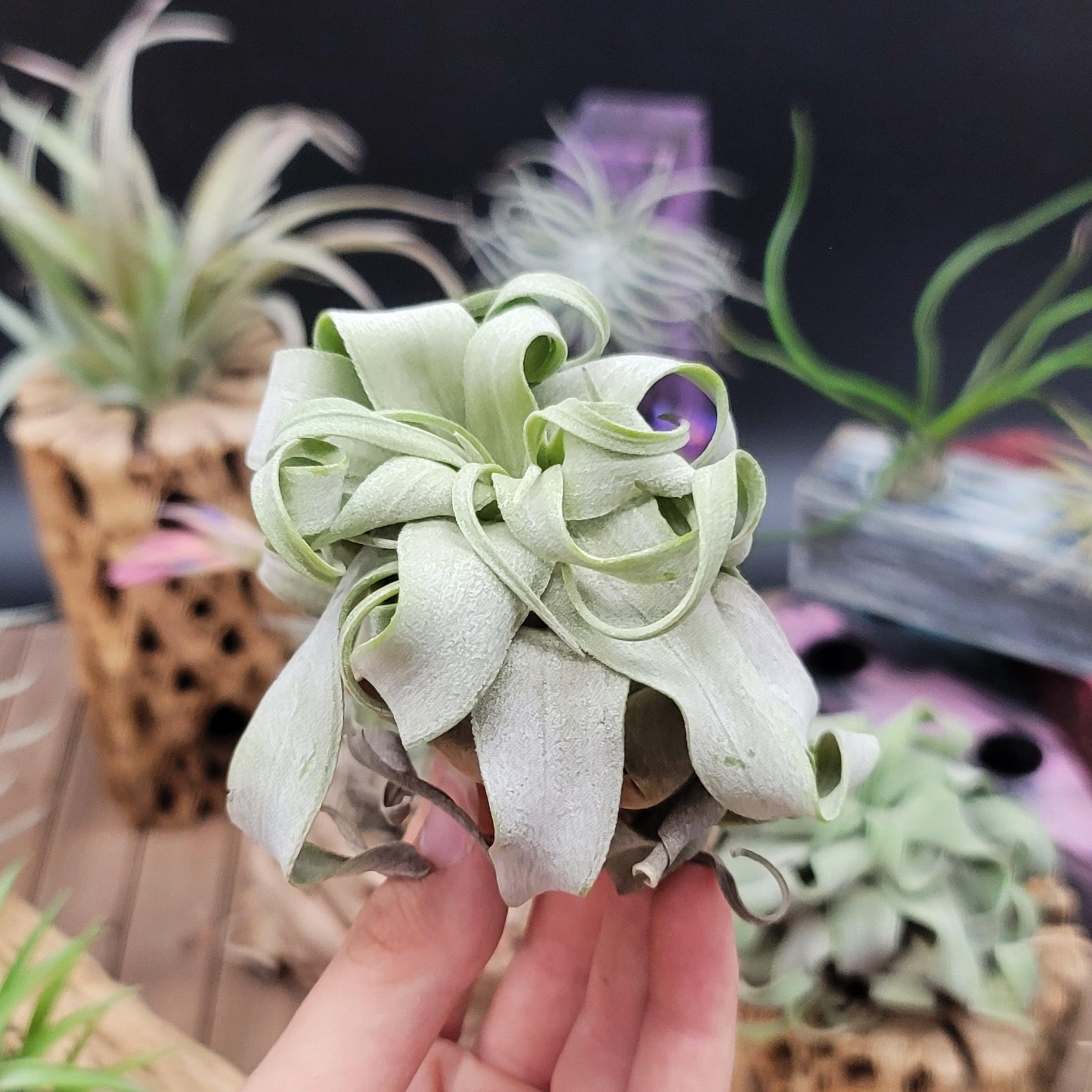
streptophylla air plant Shirley Temple 'Tillandsia streptophylla'

Sale price$20.03 Regular price$22.25
Save 10%

Pay in installments of $5.56 with ShopPay, AfterPay and Klarna

Shipping Estimate
USA
  • USA
  • CAN

Ships within 48 hours · Estimated delivery Aug 23 - Aug 28

Promo Codes Available:

For Your Every Summer RSVP, with Code: SUMMER15

Description

streptophylla air plant Shirley Temple 'Tillandsia streptophylla'Looking for a unique and striking addition to your curly epiphytic plant collection? Look no further than the 'Tillandsia streptophylla. The common name of this beautiful plant is Shirley Temple. T. streptophylla, which belongs to the Bromeliaceae family, develops much faster than most air plants. This magnificent air plant has delicate, contorted leaves that resemble the famous child actress with the curly hair of the same name. Her soft, flowing

Looking for a unique and striking addition to your curly epiphytic plant collection? Look no further than the 'Tillandsia streptophylla’. The common name of this beautiful plant is Shirley Temple.T. streptophylla, which belongs to the Bromeliaceae family, develops much faster than most air plants. This magnificent air plant has delicate, contorted leaves that resemble the famous child actress with the curly hair of the same name. Her soft, flowing tresses are known for their curls. 

Tillandsia streptophylla is a wonderful air plant native to Mexico. Growing from 6 to 8 inches in height, this variety is noted for its unique curly ringlet pastel green leaves that cascade downward in a mesmerizing fashion. As it matures, these tightly curled leaves gradually unfurl to reveal a stunning rosette shape, adding an extra touch of elegance to its already ethereal appearance. 

Some people have remarked that because of its diminutive size, Streptophylla resembles a small Xerographica. Both the Xerographica and Tillandsia Streptophylla air plants have contrasting leaves, with Xerographica having wider, thicker leaves with a rosette-like appearance and Tillandsia having thinner, flexible leaves. 

Streptophyllaair plant is relatively fast-growing. It is easy to grow and care for. TheTillandsia streptophyllaair plant flower has a lovely pink tint. The center of the plant turns pink in color throughout the blooming time, earning it the name blushing plant. 

You can propagate these air plants by seeds or by separating offsets known as pups. When the leaves of Shirley Temple are dehydrated, the edges curl outwards towards the base and make tighter ringlets.Streptophyllacare is easy to manage, making it a must-have even for beginners. Add one to your collection right away! Here at Planet Desert you can get air plants for sale online with fast shipping. 

Watering Needs

As they thrive well in dry conditions, these Tillandsia streptophylla do not need frequent watering. It prefers misting or gentle rinsing that reaches the base of the leaves and the center of the rosette. You can mist them a couple of times a week if the climate is mild. On the contrary, if you live in dry arid regions, it is best to soak your Shirley Temple in water for five minutes once every week! Do not forget to let the curly plant dry out after watering to prevent rot. Remember, it's better to underwater than overwater this curly succulent plant. 

After watering, make sure to shake off any excess water and allow your Tillandsia to dry in a well-ventilated area. It will absorb the morning dew drops through its leaves or trichomes. If given less moisture, its leaves curl inwards. 

It's important to monitor the humidity levels in your environment, and local weather conditions as it can affect the watering needs of Tillandsia Streptophylla. If the air is too dry, you can provide additional humidity by misting the plant more frequently or placing it near a humidifier. 

Light Requirements 

Tillandsia streptophyllaplants grow at their best in indoor settings. They prefer moderate to bright indirect sunlight. Avoid placing them outside in direct sunlight, as it can scorch the leaves. This Shirley temple does well in spaces with bright, filtered light, such as near a window with a sheer curtain or in a well-lit room. 

If you're unsure about the light levels in your space, you can observe the plant's leaves. If they start to turn brown or yellow, it may be an indication that the light is too intense. On the other hand, if the leaves become elongated and stretch toward the light source, it may be a sign that it needs more light. 

Remember, each plant is unique, so it's important to find the right balance of light for your Tillandsia Streptophylla. If you notice any changes in the plant's appearance, you can adjust its placement accordingly. 

Optimal Soil & Fertilizer Needs 

Tillandsia Streptophylla is an air plant that doesn't require soil. It actually absorbs nutrients and moisture through its leaves. Instead of soil, you can place the plant in a well-draining container or attach it to a piece of driftwood, cork, or other decorative objects. This allows the plant to thrive in a variety of creative displays. 

When it comes to fertilizing your Shirley temple, it's important to use a specialized air plant fertilizer. These fertilizers are formulated to provide the necessary nutrients without harming your succulent. You can dilute the fertilizer according to the instructions on the package and apply it to the plant's leaves during its regular watering routine. However, be careful not to over-fertilize, as it can lead to damage or burn the Tillandsia plant. 

Remember, air plants like Tillandsia Streptophylla are low-maintenance and don't require frequent fertilization. 

Hardiness Zone & More 

The Tillandsia Streptophylla is native to Central America and thrives in warm and tropical climates. It is generally recommended for hardiness zones 9-11, which are regions with mild winters and high temperatures year-round. These air plants prefer temperatures between 60°F and 80°F. It can tolerate slightly higher temperatures but may struggle in extreme heat or cold. It's important to protect your Shirley Temple plant from frost or freezing temperatures, as it is not frost-tolerant.  

In terms of humidity, Tillandsia Streptophylla air plant prefers moderate to high humidity levels. It is adapted to the humid environments of its native habitat. To provide optimal humidity, you can mist it with water regularly or place it in a humid location such as a bathroom or near a humidifier. However, be careful not to overwater the plant, as it can lead to rot or other issues. 

Don't miss out on this opportunity to add something truly exceptional to your garden. Order your very own Tillandsia streptophylla - Shirley Temple plant today! 

Shipping Notes
  • Free Standard Shipping on $100+ Orders to the USA.
  • Except Preorder products are shipped in 48 hours.
  • Delivery to the USA:
  1. Standard Shipping : 3-10 business days
  • If time is of the essence, please consider selecting expedited delivery for faster service.
Exchange/Return Notes
  • We offer a 30-day return/exchange service after receiving.
  • Final sale items are not eligible for returns or exchanges.
  • To process your return/exchange, please contact us at [email protected]
  • Please click here for more details>>> Return & Exchange Policy
SKU: 83999958999

Discover Niche Categories That Outsell streptophylla air plant

Top-Converting Item to Boost Your Average Order

4.5 ★★★★★
Based on 6 reviews
Sort
Highest Rating
Newest First
Oldest First
Product Reviews
T
Verified Purchase
Todd
Cuba, US
★★★★★ 5
How Facebook lost its conscience, and how the young man at its helm grew to love the taste of power
Format: Hardcover
A WORD ABOUT THIS PLATFORM THAT CONNECTS US Careless People by Sarah Wynn-Williams This riveting memoir about the maturation of Facebook is fascinating in large part because of the direct access the author had for over six years to the highest levels of leadership at the company. Its title comes from The Great Gatsby, where narrator Nick Carraway says, “They were careless people, Tom and Daisy — they smashed up things and creatures and then retreated back into their money.” A former New Zealand diplomat, Wynn-Williams had to pitch her own job to Facebook in 2011, as Zuckerberg and other senior leaders had no clue then about the role Facebook was destined to play in global politics. Rising to the position of Director of Global Public Policy, Wynn-Williams had a front-row seat to decisions that would irrevocably alter the political landscape in the US and around the world. Fast forward to the 2016 presidential election and the author’s account of how Facebook’s microtargeting of users, its allowance of misinformation on the site, and its assignment of staff to work hand in glove with the Trump campaign as they utilized these ethically compromised tactics turned the tide in that election, and set the stage for the wrecking ball now swinging in our halls of government. You could say Careless People is the story of how Facebook lost its conscience, and how the curious and impressionable young man at its helm grew to love the taste of power. The author weaves the story of Facebook’s role in the 2016 election with a number of other narratives, all revealing the same pattern showing how principled concerns were steamrolled by the relentless pursuit of growth, revenue, and influence. See also Cory Doctorow’s engaging review of this book, with its helpful explanation of why continued growth is so important to a company like Facebook. Her account reads like a slow-building tragedy, where you see exactly where the off-ramps were and watch, helplessly, as they pass by one by one: The Rohingya Genocide This is perhaps the most devastating section of the book. Wynn-Williams argues that Facebook failed to moderate hate speech against the Rohingya in Myanmar, and that the company only had two Burmese language moderators for the entire country. Facebook had also failed to invest in Burmese language support for its automated systems, meaning none of its moderation tools could even parse posts written in Burmese script. Because of these decisions, hate speech and misinformation designed to stoke ethnic and religious division spread like wildfire across the platform, and the genocide that followed is presented as a direct consequence of this reckless neglect. Censorship for China A chilling revelation for anyone who believes in free speech is Facebook’s willingness to compromise its own foundational values in pursuit of access to the Chinese market, which Zuckerberg seems to have perceived as a kind of final frontier and holy grail. Rather than standing firm on the principles of open communication it so publicly champions, Facebook secretly developed what was essentially a bespoke censorship tool designed to win over a Chinese government playing hard to get. If China had decided to allow Facebook through the Great Firewall, this system would have allowed Beijing to suppress content it found politically inconvenient, and would have extended into Hong Kong. One subnarrative in this thread is the lengths to which Zuckerberg went to court President Xi Jinping. He asks him (in Mandarin) to name his firstborn child (Xi declines), and the author includes an entertaining depiction of one-upmanship of Xi over Zuckerberg when the latter seeks unsuccessfully to arrange an impromptu meeting with Xi (since Xi had repeatedly rejected overt requests to meet). Sexual Harassment Culture For a company that spent years wrapping itself in the language of feminine empowerment and progressive values — most visibly through COO Sheryl Sandberg’s “Lean In” movement — the picture Wynn-Williams paints inside Facebook’s walls is a study in hypocrisy. The book alleges that sexual harassment by senior executives was not only tolerated but effectively shielded from consequences. Monetizing Teenage Insecurity Wynn-Williams reveals that Facebook identified teenage girls who had deleted selfies on Facebook, Instagram, and WhatsApp, and then forwarded their data to companies who used it to target them with beauty products. Let that sink in for a moment. These were young girls navigating the minefield of adolescent insecurity, who made a conscious decision to take their photos down. And rather than respecting that decision, Facebook treated it as a data point to be monetized. Content Moderation as a Political Tool At the heart of this memoir is the question of how Facebook decides what speech is acceptable and what isn’t, both in the US and across the world. Facebook has spent years presenting its content moderation decisions as principled, values-driven calls — the careful work of a responsible company trying to balance free expression with public safety. However, the author shows, an internal policy established in February 2015 made the actual workings explicit: when governments requested that content be removed, Facebook would only comply if there was a credible threat to block the platform entirely in that particular country or a risk to its own employees. Numerous examples paint a picture of a company that was essentially making it up as it went along — complying with take-down requests when powerful enough governments (such as China) pushed hard enough, and ignoring everyone else.​​​​​​​​​​​​​​​​ Most of us have encountered, in one way or another, Facebook’s self-described “Community Standards,” which, the company states, “are written to ensure that everyone’s voice is valued.” “Facebook,” the language continues, “takes great care to craft policies that are inclusive of different views and beliefs- in particular those of people and communities that might otherwise be overlooked or marginalized.” However, the picture the author reveals in Careless People suggests that such language is mostly posturing. Zuckerberg’s Ego and Detachment One of the most fascinating and unsettling threads running through the book is the portrait Wynn-Williams paints of Mark Zuckerberg — a man who began as a socially awkward but genuinely curious young idealist and somewhere along the way became something different. One anecdote about Indonesia is comic in its brazenness: Zuckerberg allegedly demanded that Wynn-Williams organize an entirely staged, artificial mob of fans to “gently” swarm him in public, creating the illusion of organic, spontaneous popularity. His staff routinely let him win at board games on his private jet, and he remains oblivious to that fact until the author finally spells it out one day. After the 2016 election, when Obama dresses him down at the APEC summit in Peru about Facebook’s role in swinging the results, he becomes indignant, and instead of recognizing an opportunity for a course correction, he contemplates a run for president himself, instructing his staff to take him on a grassroots tour of the country that includes all the requisite stops for a presidential candidate. Throughout the book, we see a leader increasingly insulated from the consequences of his own decisions, surrounded by people too afraid or too incentivized to speak the truth to his face. What makes the author’s account of this man and his company compelling is that initially she believed in the mission. She was there because she thought Facebook could be a genuine force for good in the world–a way to connect people, a uniquely powerful democratizing force. In that sense she probably stands in for most of us who are here right now because we recognized these same qualities ten or fifteen years ago. But now we feel tremors beneath us and the ground shifting in unsettling ways as we post and scroll and message here. What is this platform becoming? What are our responsibilities to bear witness to that and to respond? I believe this book can help us answer those difficult questions. As a footnote, consider that when the book was published, Meta immediately filed an emergency legal action to prevent Wynn-Williams from publicly promoting it, citing a non-disparagement agreement she signed on leaving the company. The attempt backfired in the way these things tend to: the book reached number one on the New York Times best-seller list, and Wynn-Williams was invited to testify before the U.S. Senate. Meta’s attempts to disparage the author read as transparent and cynical in the face of the credibility she establishes throughout this book. And its efforts to limit her voice have only become additional evidence supporting the story she has told. If you’re looking for a book that explains how we got to the crazy, upside-down world we are living in now — politically, socially, technologically — Careless People is a great place to start.
WAS THIS REVIEW HELPFUL?YesReportShare
Reviewed in the United States on February 19, 2026
O
Verified Purchase
Onyx Parrot
Port Orchard, US
★★★★★ 5
Great inside view of Facebook's corrupt behavior.
Format: Hardcover
I've always been creeped out by Facebook, and avoid all of their services. This book confirms the wisdom of this. The author is tough (literally surviving a shark attack as a teenager!) and smart. After getting a law degree in her native New Zealand, she climbs the ladder in a diplomacy career, working in New York and Washington DC. In the late 2000's she (idealistically) sees potential in Facebook as a global communications tool, and after aggressively pursuing a position there manages to land a job at Facebook's Washington DC office helping to manage their international affairs. Her work at Facebook starts off chaotic but hopeful. Her experience with international affairs as the company wakes up to their global opportunities lands her in the company's C-suites, escorting and introducing executives to world leaders as they expand their global influence. Things start to go off the rails when Facebook's leaders observe their large (and profitable!) political influence with the rise of Donald Trump. Observing this facility to use Facebook for promoting other leaders around the world (many corrupt), the original idealism goes out the window as Facebook cashes in on becoming a global propaganda and manipulation tool. Wynn-Williams had a front row seat to all of this, as well as some really ugly workplace behavior, left unchecked. She's a great storyteller. The book is well worth reading if you're curious about how the company (now "Meta") regards the world's attention it harvests for maximum profit. My only disappointment with the book is the Cambridge Analytica scandal is only mentioned in passing, even though it occurred during the author's tenure at the company. I'd be interested in her observations on it, even if she wasn't directly involved.
WAS THIS REVIEW HELPFUL?YesReportShare
Reviewed in the United States on January 18, 2026
A
Verified Purchase
Adele S.
West Palm Beach, US
★★★★★ 3
Hard to review.
Format: Kindle
The good: It was the only book eligible for the Buzzworthy achievement for the summer reading challenge that I had any interest in and it's available on Kindle Unlimited, so YAY. There is also a very engaging quality to the writing to make it readable. The bad: This is not, in my opinion, a whistleblower's memoir. There is too much fondness, nostalgia and pride in many of these stories. You can just tell that she's been using alot of this to regale others while working for FB and since leaving. Time and the totality of the experience haven't changed the fact that she clearly loved what she was doing and real whistleblowers are more jaded, cynical, burntout and/or betrayed by everything they've been through. I may have been wrong in expecting this to be a whistleblower's story, but if you're testifying before a Senate Judiciary Committee, like she did, I expect more whistleblowing. I also expect to feel more strongly about FB (the focus of the revelations) than the author, but I have so many notes and highlights that comment on the author because I already knew much of this and deleted my FB 10 years ago now, but I knew nothing about this person until reading the memoir. My impression is not good, but I still don't know anything to speak to them as a person. I will say that I was extremely frustrated early on by her "I'm just a random person from New Zealand" shtick. Randos don't get anywhere near the spaces that she had been, was currently in and was going to be in. The inability to see their own privilege and complicity makes it hard for me to feel anything really positive about this read. I got my achievement badge, though, so there's that.
WAS THIS REVIEW HELPFUL?YesReportShare
Reviewed in the United States on July 21, 2025
B
Verified Purchase
Bob A. Rowden
Omaha, US
★★★★★ 4
Valuable and Engaging Book but with Poor Timing - It's Our Fault, too.
Format: Kindle
If this is not enough reason for companies and individuals, with even a sliver of good judgement, to stop using all Meta products ASAP, I am not sure what is. Careless People is consistent with, builds upon and confirms what both the "Real Facebook Whistleblower," Frances Haugen (The Power of One) and Jeff Horwitz (Broken Code) have already brought us. While Wynn-Williams did not have the mountains of solid evidence that I believe made the work of Haugen and Horwitz more important, Careless People does provide an interesting perspective and more detail, not only on Meta's failures caused by the drive for more profit, but also the profound personality flaws of Meta's top people. Assuming Careless People is reasonably accurate, Sarah Wynn-Williams is a very brave, resilient woman who wanted to do the right thing for Meta. She sacrificed way too much to help Meta when they did not deserve it. She offers a descriptive account of the difficulties she encountered in her role, including cases of bizarre sexual harassment and being sent to dangerous places all over the world. Even if these are exaggerated, the creativity she had in handling such situations makes the book so interesting to read. So many things went wrong for Wynn-Williams that would have caused many of us to give up, but she kept fighting (like Haugen). While any book providing the reasons why we all need to stop using Meta products is good progress, I am disappointed that Wynn-Williams never mentions Haugen or Horwitz in the acknowledgments or gives them credit for paving the way. I would have expected this at a minimum, since those books have been out since 2021 and those authors have provided abundant proof of Meta's world-wide and excessive damage - 22,000 pages of such proof (see the "2021 facebook leak" on Wikipedia) . As of March 2025, Wynn-Williams had never reached out to either of those two, nor offered to collaborate with them. Jeff Horwitz has interviewed hundreds of former Meta employees. Wynn-Williams left facebook in 2017. So while she offers more detail about what was wrong at Meta, she seems too late. And without any credit to the others, especially Frances Haugen, who risked just as much, if not more than Wynn-Williams, it seems strange that Wynn-Williams would now finally come forward, suspiciously looking like an attempt to use their success towards her own. That part still needs to be answered. The obvious lesson is that the 3 billion users of Meta products are "Careless," too. Nothing changes a company's behavior faster than when people stop using its products. For more than 6 years, since Roger McNamee published "Zucked: Waking Up to the Facebook Catastrophe" in 2019, we have known that Meta products suck the data out of users to sell it to anyone willing to pay for it. If you use any Meta products yourself and/or never bother to check that any website you are using, is sending your data to Meta with everything you click on (many tools are available to help you with this), but yet you claim to be an opponent of Trump, you have no one to blame but yourself. Meta gets away with the disastrous and horrific fallout of their carelessness BECAUSE WE LET THEM! In fact, given what Wynn-Williams has brought us, along with the others before her, can't we simply conclude that it is POOR JUDGEMENT for any person or company to actually use Meta, Inc. products in 2025? Meta is similar to the tobacco companies in the 70s who were not doing anything illegal (arguably still TBD for Meta). We all knew their products were dangerous, but so many continued to use them. Hopefully it will not take decades for people to change in this case. So unless there is some miraculously speedy and unprecedented exodus from Meta's user base, look for someone worse than Trump in the 2028 general election and 535 more of them in Congress now that the word is out that all you need are friends at Meta to get elected. Hang on because it's going to get much worse.
WAS THIS REVIEW HELPFUL?YesReportShare
Reviewed in the United States on April 12, 2025
S
Verified Purchase
Samuel Lou Zhengzhi
Birmingham, US
★★★★★ 5
The modern Great Gatsby
Format: Hardcover
It is a very interesting (words) and depressing (reality) book to read. As a former Facebook employee, this book allows me to reflect my time at the company from a new angle, confirming some of the hypothesis I had, and shedding great insights into my experience. Thank you Sarah for sharing her story. We are all in this together.
WAS THIS REVIEW HELPFUL?YesReportShare
Reviewed in the United States on May 25, 2026

recommand products